Discover the 15+ critical evaluation mistakes that cause 87% of traders to fail their Apex Trader Funding challenge. Our expert prop firm passing service has helped thousands of traders avoid these costly errors and secure their funded accounts.
The prop firm passing service industry has witnessed explosive growth in 2026, with Apex Trader Funding emerging as one of the most popular futures prop firms for traders seeking funded accounts. However, despite the appealing promise of trading with up to $300,000 in capital, the reality is that over 87% of traders fail their Apex evaluation on their first attempt. The primary reason? Critical evaluation mistakes that could have been avoided with proper knowledge and preparation.
At All Prop Funding, we’ve analyzed thousands of failed Apex Trader Funding evaluations to identify the exact patterns and mistakes that lead to account failure. As a leading funded account management service, we’ve helped over 5,000 traders successfully navigate the Apex evaluation process and secure their funded accounts. This comprehensive guide reveals the 15+ most common Apex Trader Funding evaluation mistakes and provides actionable solutions to help you pass your challenge on the first attempt.
Understanding Apex Trader Funding evaluation rules is not optional—it’s essential for survival. The difference between passing and failing often comes down to a few critical decisions around risk management, drawdown awareness, and consistency. Our prop firms passing services have refined these insights into a proven system.
Whether you’re a complete beginner exploring prop firm services for the first time or an experienced trader who has struggled with the Apex evaluation, this guide will transform your approach. We’ll cover everything from the intricacies of the trailing drawdown rule to the psychological traps that cause traders to blow their accounts, providing you with the knowledge needed to join the elite 13% who pass on their first attempt.
The Apex Trader Funding evaluation is designed to test not just your trading skills, but your discipline, risk management, and emotional control. Many traders approach the evaluation with the same mindset they use for personal trading accounts, only to discover that the prop firm environment demands a completely different approach. The mistakes outlined in this guide represent the most common pitfalls we’ve observed across thousands of evaluations, and understanding them is your first step toward success.

Apex Trader Funding is a leading futures prop firm that provides traders with funded accounts ranging from $25,000 to $300,000. Founded with the mission of identifying and funding talented traders, Apex has grown to become one of the most recognized names in the prop trading industry, with thousands of funded traders actively trading futures markets including the E-mini S&P 500 (ES), Nasdaq 100 (NQ), crude oil (CL), gold (GC), and more.
The Apex evaluation process consists of two phases: the Evaluation phase and the Verification phase. Traders must achieve specific profit targets while adhering to strict risk management rules, including maximum drawdown limits, daily loss limits, and consistency requirements. Once both phases are successfully completed, traders receive a funded performance account with profit splits of up to 100%.
Before diving into the common mistakes, it’s essential to understand the core rules that govern the Apex evaluation. These rules are non-negotiable, and violating any of them results in immediate account failure.
Achieve the required profit target (varies by account size) during the evaluation phase. Typically 6% for evaluation and 3% for verification.
The trailing drawdown follows your unrealized profits during the trading day. This is the #1 reason traders fail the Apex evaluation.
Maximum daily loss limit varies by account size. Exceeding this limit at any point during the trading day results in immediate failure.
No single trading day can account for more than 30% of your total profits. This ensures consistent trading performance.
Apex requires a minimum of 7 trading days for evaluation and 7 for verification. Rushing to pass in fewer days often leads to mistakes.
Certain high-impact news events may have trading restrictions. Violating these rules can result in account failure.
These are the exact mistakes that cause 87% of traders to fail their Apex Trader Funding evaluation. Understanding and avoiding each one is critical to your success.
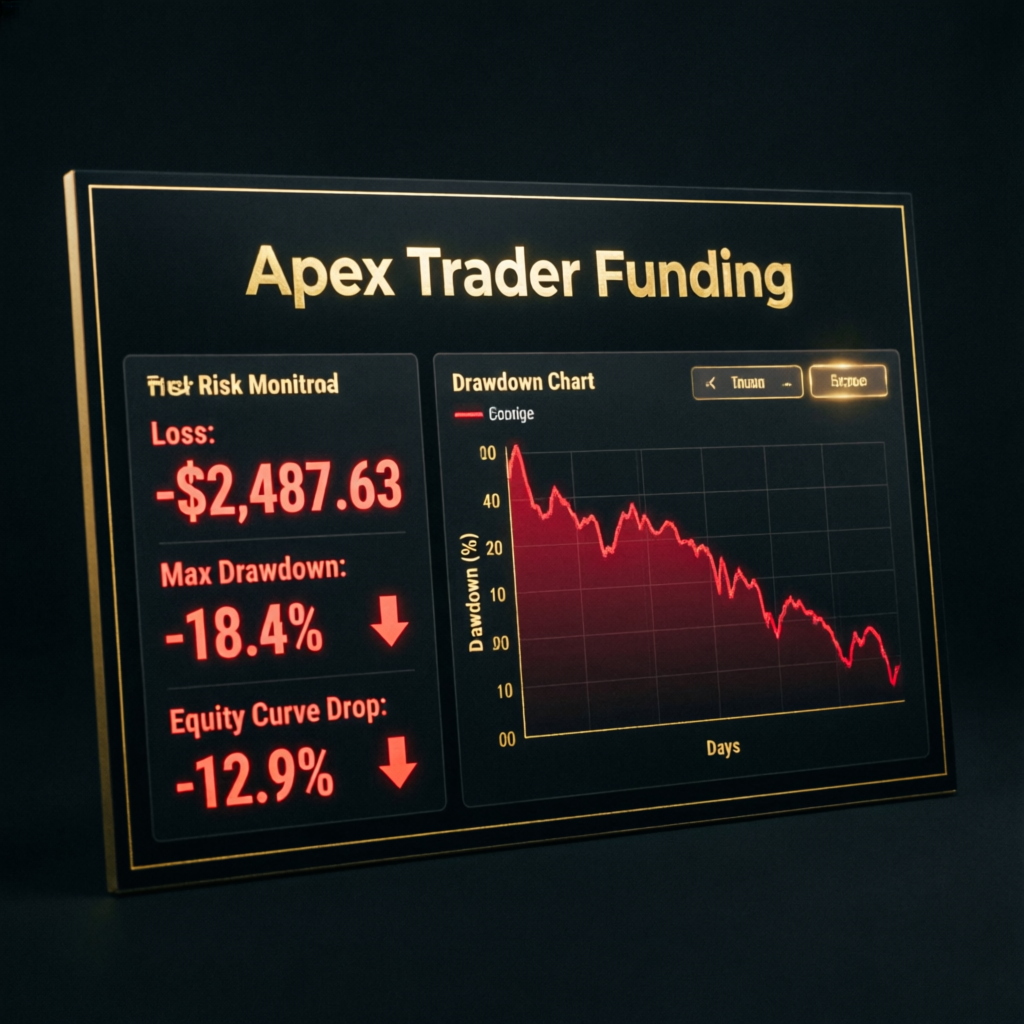
The trailing drawdown is the #1 reason traders fail the Apex Trader Funding evaluation. Unlike a static drawdown that remains fixed, the trailing drawdown follows your unrealized profits during the trading day. This means if your account reaches a new high-water mark during the day, the drawdown level moves up with it—and it does NOT move back down when your profits decrease.
For example, if you’re trading a $100,000 account with a $4,000 trailing drawdown, and your account reaches $103,000 in unrealized profits during a trade, your new drawdown level becomes $99,000. If the trade then reverses and you close at $101,000, your drawdown level remains at $99,000—not $96,000. This subtle but critical difference has destroyed thousands of evaluations.
Solution: Always calculate your risk based on the highest unrealized profit of the day, not your starting balance. Use a trading journal to track your intraday high-water mark.
One of the most destructive mistakes in any prop firm passing service context is overleveraging. Many traders, excited by the prospect of trading large account sizes, immediately jump to maximum position sizes without considering the risk. Trading 10 contracts on a $50,000 account might seem profitable when you’re winning, but a single adverse move can trigger the daily loss limit or trailing drawdown.
Professional traders typically risk no more than 1-2% of their account per trade. On a $100,000 Apex account, this means risking $1,000-$2,000 per trade. With the E-mini S&P 500 (ES) moving approximately $50 per contract per point, a 20-point adverse move on 4 contracts would result in a $4,000 loss—potentially breaching your drawdown limit in a single trade.
Solution: Start with 1-2 contracts maximum, regardless of account size. Scale up only after demonstrating consistent profitability. Our funded account management services recommend this approach for all clients.
The Apex consistency rule is designed to prevent traders from passing the evaluation through a single lucky trade. The rule states that no single trading day can account for more than 30% of your total profits. Many traders ignore this rule until they’re close to passing, only to discover they’ve violated it and need to trade additional days to dilute their largest profitable day.
For example, if you’ve made $5,000 in total profits and your largest day was $2,000, that day represents 40% of your profits—violating the 30% rule. You would need to make additional profits on other days until your largest day represents less than 30% of the total. This often requires an additional $1,667 in profits (making total profits $6,667, where $2,000 is 30%).
Solution: Track your consistency ratio daily. Aim for profits distributed across at least 10-15 trading days with no single day exceeding 25% of total profits (leaving a buffer).
Revenge trading is an emotional response to losses where traders attempt to “make back” their money by taking larger, riskier trades. This is particularly dangerous in the Apex evaluation environment because the trailing drawdown doesn’t forgive emotional decisions. A trader who loses $1,500 in the morning might take a 5-contract trade in the afternoon to recover, only to lose another $3,000 and breach their drawdown limit.
The psychological pressure of the evaluation amplifies revenge trading tendencies. Traders feel they’re “running out of time” or “losing their chance,” leading to increasingly desperate decisions. Professional traders recognize that losses are part of the business and maintain their position sizing regardless of recent performance.
Solution: Implement a mandatory “cooling off” period after 2 consecutive losses. Step away from the screens for at least 2 hours. Our prop firm passing EA systems include automated loss limits to prevent revenge trading.
High-impact news events like Non-Farm Payrolls (NFP), FOMC announcements, CPI releases, and GDP reports can cause extreme volatility that easily triggers drawdown limits. Many traders attempt to trade these events, believing they can predict the direction, only to get stopped out by whipsaw price action or experience slippage that exceeds their risk parameters.
During NFP releases, the ES can move 50-100 points in seconds, which translates to $2,500-$5,000 per contract. Even if you’re directionally correct, the initial whipsaw can trigger your stop loss before the move continues in your favor. Professional traders typically avoid trading 15 minutes before and after high-impact news events.
Solution: Maintain an economic calendar and avoid trading 30 minutes before and after high-impact events. Focus on technical analysis during low-volatility periods for more predictable price action.
Many traders enter the Apex evaluation without proper stop loss discipline, either using stops that are too wide (risking too much per trade) or too tight (getting stopped out by normal market noise). The key is finding the right balance based on market structure and volatility, not arbitrary dollar amounts.
A common mistake is placing stop losses at round numbers or obvious support/resistance levels where many other traders have placed their stops. Market makers often target these levels to trigger stop runs before reversing. Professional traders place stops beyond these obvious levels, giving their trades room to breathe while still protecting capital.
Solution: Use ATR (Average True Range) to determine appropriate stop loss distances. Place stops beyond recent swing highs/lows with a buffer of 1-2 ticks. Never move stops further away from entry once a trade is active.
The pressure to pass the evaluation quickly leads many traders to overtrade—taking low-quality setups just to be “in the market.” This results in a high volume of marginal trades with poor risk-reward ratios, increasing the likelihood of hitting drawdown limits through accumulated small losses.
Quality always trumps quantity in trading. Professional traders might only take 2-3 high-quality setups per day, waiting patiently for the market to come to them. Overtraders, by contrast, might take 10-15 trades per day, each with marginal setups, resulting in death by a thousand cuts as commissions and small losses accumulate.
Solution: Define your A+ setups clearly and only trade when all criteria are met. Limit yourself to 3-5 trades per day maximum. Use a trading checklist to avoid impulsive entries.
Many traders focus solely on win rate without considering risk-to-reward ratios. A strategy with a 70% win rate but 1:0.5 risk-reward will lose money over time, while a strategy with a 40% win rate but 1:3 risk-reward will be highly profitable. The Apex evaluation rewards traders who understand this mathematical reality.
The minimum recommended risk-reward ratio for the Apex evaluation is 1:2, meaning you risk $1 to make $2. This allows you to be wrong 60% of the time and still be profitable. Many failed evaluations show traders taking trades with 1:1 or worse risk-reward, requiring an unsustainable win rate to pass.
Solution: Only take trades with a minimum 1:2 risk-reward ratio. Calculate your potential profit target before entering the trade. If the setup doesn’t offer at least 1:2, skip it entirely.
Hope is not a trading strategy, yet many traders hold losing positions far beyond their planned stop loss, hoping the market will reverse. This behavior is particularly dangerous in the Apex evaluation because the trailing drawdown continues to work against you as unrealized losses grow, potentially triggering account failure before you even close the trade.
The psychological trap of “it will come back” has destroyed more evaluations than almost any other mistake. Professional traders cut losses quickly and let winners run—the exact opposite of what most retail traders do. They understand that a small loss today preserves capital for future opportunities.
Solution: Set hard stop losses before entering every trade and honor them without exception. Use automated stop orders that execute immediately when hit. Never move stops further from entry.
Many traders complete the Apex evaluation successfully only to discover they don’t understand the activation requirements for the funded account. This includes the activation fee, data fees, platform requirements, and the transition rules from evaluation to funded status. Failing to prepare for these requirements can delay or prevent access to your funded account.
The activation fee is a one-time cost that varies by account size, and data fees are ongoing monthly charges for market data subscriptions. Additionally, traders must connect their funded account to a supported platform like NinjaTrader, Tradovate, or Rithmic, which requires technical setup and familiarity with the platform’s interface.
Solution: Review all activation requirements before starting the evaluation. Budget for activation fees and data subscriptions. Set up your trading platform in advance to ensure a smooth transition.
The Apex evaluation allows trading multiple futures instruments, but many traders jump between ES, NQ, CL, GC, and other markets without developing expertise in any single instrument. Each market has unique characteristics, volatility patterns, and optimal trading times. Spreading attention across multiple instruments leads to mediocre performance in all of them.
Professional traders typically specialize in 1-2 instruments, developing deep understanding of their behavior, typical ranges, and optimal setups. The ES (E-mini S&P 500) is the most popular choice for Apex evaluations due to its liquidity, predictable behavior during regular trading hours, and reasonable volatility.
Solution: Choose 1-2 instruments and master them. Study their typical daily ranges, optimal trading times, and common patterns. Avoid the temptation to trade every market that moves.
Trading without a written plan is like driving without a map—you might reach your destination eventually, but you’ll waste time, fuel, and likely get lost along the way. The Apex evaluation demands precision and discipline, both of which require a clearly defined trading plan that specifies entry criteria, exit rules, position sizing, and risk management parameters.
A comprehensive trading plan includes your market selection, timeframes, specific setup criteria, entry and exit rules, position sizing formula, daily loss limits, and performance review process. Without this plan, traders make decisions based on emotions and market noise rather than a systematic approach.
Solution: Create a detailed written trading plan before starting the evaluation. Include specific, measurable criteria for every aspect of your trading. Review and refine the plan weekly based on performance data.
The daily loss limit is a hard rule in the Apex evaluation—exceed it even by $1 and your account is failed. Many traders focus so much on the trailing drawdown that they forget about the daily loss limit, which resets at the end of each trading day. This limit is typically $1,000-$3,000 depending on account size.
The danger of the daily loss limit is that it applies to realized AND unrealized losses during the trading day. If you’re down $2,500 on an open trade and your daily limit is $3,000, you only have $500 of room before failure—even if you believe the trade will reverse. Professional traders monitor their daily P&L continuously and stop trading when they reach 70-80% of their daily limit.
Solution: Set a personal daily loss limit at 70% of the official limit. Use platform alerts to notify you when you reach 50% and 70% of your daily limit. Stop trading immediately when you hit your personal limit.
Futures markets trade nearly 24 hours a day, but not all trading hours are created equal. The most liquid and predictable price action occurs during the regular trading hours (RTH) of 9:30 AM to 4:00 PM ET for equity index futures. Trading during the overnight session or the lunch hour often results in choppy, unpredictable price action that’s difficult to trade profitably.
Many traders, especially those in different time zones, attempt to trade during off-hours when liquidity is low and spreads are wide. This leads to poor fills, slippage, and erratic price movements that can trigger stop losses unnecessarily. The best approach is to focus on the first 2 hours and last hour of RTH when volume and volatility are highest.
Solution: Trade primarily during 9:30-11:30 AM ET and 3:00-4:00 PM ET. Avoid the lunch hour (12:00-2:00 PM ET) and overnight session unless you have a specific strategy for those times.
A trading journal is the single most important tool for improvement, yet most traders fail to maintain one consistently. Without a journal, you’re trading blind—unable to identify patterns in your mistakes, track your progress, or make data-driven decisions about your strategy. The Apex evaluation is a learning process, and the journal is your textbook.
A comprehensive trading journal should include entry and exit times, instrument traded, position size, entry and exit prices, stop loss and profit target levels, setup type, emotional state, market conditions, and lessons learned. Reviewing this data weekly reveals patterns that would otherwise remain hidden, allowing you to refine your approach continuously.
Solution: Use a digital trading journal like Edgewonk, TraderSync, or a custom spreadsheet. Review your journal weekly to identify patterns. Focus on eliminating your most common mistakes first.
Choose the right account size for your experience level and risk tolerance
| Account Size | Profit Target | Trailing Drawdown | Daily Loss Limit | Evaluation Fee |
|---|---|---|---|---|
| $25,000 | $1,500 | $1,500 | $1,000 | $39 |
| $50,000 | $3,000 | $2,500 | $1,500 | $59 |
| $100,000 | $6,000 | $4,000 | $2,500 | $109 |
| $150,000 | $9,000 | $5,000 | $3,000 | $169 |
| $300,000 | $18,000 | $10,000 | $5,000 | $319 |
Pro Tip: Start with the $50,000 or $100,000 account for your first Apex evaluation. These sizes offer a good balance between profit potential and manageable risk. Our prop firm passing service recommends the $100K account for traders with at least 6 months of experience.
Follow this proven 7-step framework used by our successful clients to pass the Apex evaluation consistently.
Develop deep expertise in a single high-probability setup. Trade it exclusively during the evaluation to build consistency and confidence.
Never risk more than 1% of your account per trade. This ensures you can survive a losing streak without breaching drawdown limits.
Start with minimal position size regardless of account size. Scale up only after demonstrating consistent profitability over 20+ trades.
Trade only during regular trading hours (9:30 AM – 4:00 PM ET) when liquidity is highest and price action is most predictable.
Monitor your consistency ratio daily to ensure no single day exceeds 25% of total profits. Adjust position sizing if needed.
Always use automated stop loss orders. Never move stops further from entry. Cut losses quickly and let winners run.
Document every trade with entry/exit details, setup type, and emotional state. Review weekly to identify and eliminate patterns.
Stay out of the market 30 minutes before and after high-impact news events. The volatility can easily trigger drawdown limits.
Consider using our funded account passing service for expert guidance and proven strategies that have helped thousands pass.
Join thousands of successful traders who have used our prop firm passing service to secure their funded accounts. With a 92% success rate and expert guidance, we’re here to help you achieve your trading goals.
Everything you need to know about Apex Trader Funding evaluations